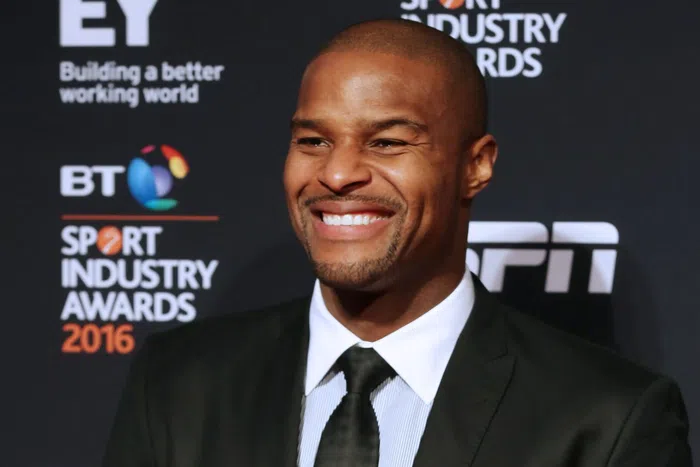
After flying the flag for Nigeria and the African continent in the NFL for over a decade, Osi Umenyiora is now tasked with leading the league’s efforts to identify and develop talent from outside the United States—particularly in Africa. The retired two-time Super Bowl-winning defensive end for the New York Giants has played a key role in the sport’s growth across the continent. His eye for talent has helped the league create new pathways for international players to learn the game while gaining exposure to NFL teams, coaches, and even college programs.
Fresh off a stellar playing career, the London-born, Anambra-native didn’t take long to find his purpose after stepping away from the game.
“I think maybe a week after I retired, I was in England going to the NFL offices 9–5,” he said. “I didn’t really have time to process retirement the way most people do. There was no real downtime. I just went straight to work. I didn’t know exactly what I was going to do—and to be honest, I don’t think Mark Waller, who hired me, did either. But being in that environment, ideas started to come, especially being around people who could help make things happen.
“There was no real plan. I just knew I didn’t want to stay in America doing the same things everyone else does. With my background and network, I was able to speak to the commissioner years before I retired about what I wanted to do. It just so happened that the opportunity was there at the right time.”
Those early conversations led to the creation of a groundbreaking initiative.
“The International Player Pathway (IPP) program was an idea I came up with within two weeks of arriving in London,” Umenyiora explained. “Alongside Aden Durde, we started discussing how to grow the game globally. We knew that if the NFL wanted to expand internationally, it needed players from those regions.
“At the time, the NFL was present in many countries—on TV, generating revenue—but there was no clear pathway for players from those countries to enter the league. It made sense to build one. Initially, we looked everywhere, but we quickly noticed that many athletes with elite traits were of African descent, whether in the UK, Germany, or elsewhere.
“We also realized there were already many African players in the NFL, in college, and in high school in the U.S. That showed us there’s a natural ability there. So instead of just doing charity work in Africa, we thought—why not create opportunities for people to help themselves? That’s how the program was born.”
The results have been encouraging.
“We’ve had 11 or 12 players come through the program—six on NFL practice squads, one at the University of Tennessee who’s doing really well, and five at the NFL Academy in the UK, some of whom already have scholarship offers. We’ve also taken current NFL players back to Africa, hosting camps in Ghana and Nairobi. It’s become a full-circle moment—giving back while building the future.”
Looking ahead, Nigeria could be next on the list for development camps.
“I’m about 70% sure the next camp will be in Nigeria,” he said. “The timing feels right. That’s where many of the players are from. We would have gone there first, but there were some challenges we had to consider. We just have to be mindful of those.”
Beyond camps, the NFL has also tested fan engagement initiatives on the continent. The NFL Experience event in South Africa proved hugely successful.
“That event was incredible,” Umenyiora said. “It was packed—lines out the door. I had no idea there were that many NFL fans in South Africa. I’m not sure it will be an annual thing, but it showed us where strong fan bases exist. Now it’s about building on that in places like Cape Town and beyond.”
With the NFL increasingly focused on hosting games internationally, the question of an African-hosted game is inevitable.
“South Africa would probably be the most likely option because of the infrastructure,” he noted. “Maybe Rwanda as well. Senegal is making progress, and Nigeria has potential too. Pre-season games could be a starting point—but if other countries are getting regular-season games, we’d want the same for Africa. That said, we’re still a long way off.”
Umenyiora’s ambitions don’t stop there. His latest venture is the Uprise Flag Football League, aimed at developing elite talent in a fast-growing format of the sport.
“This was our first season, and it went well,” he said. “Organizing something at that scale in Nigeria came with challenges, but overall it exceeded expectations. The team owners—many of them NFL players—were fully engaged, which was great. The kids enjoyed it, but we didn’t identify as many top-tier athletes as I’d hoped, so we’ll need to improve our scouting.
“Next season, we want more teams and higher-level athletes. With flag football now part of the Olympics, we need to start developing players who can compete at an elite level. We’ll eventually expand into different age groups and include women, but for now the focus is on top-tier talent.”
As the number of first- and second-generation African players in the NFL continues to rise, one thing is clear: Osi Umenyiora’s impact on the league—and on the continent—is profound. Through his work, countless young athletes are gaining opportunities not just in football, but in education and life beyond the game.